
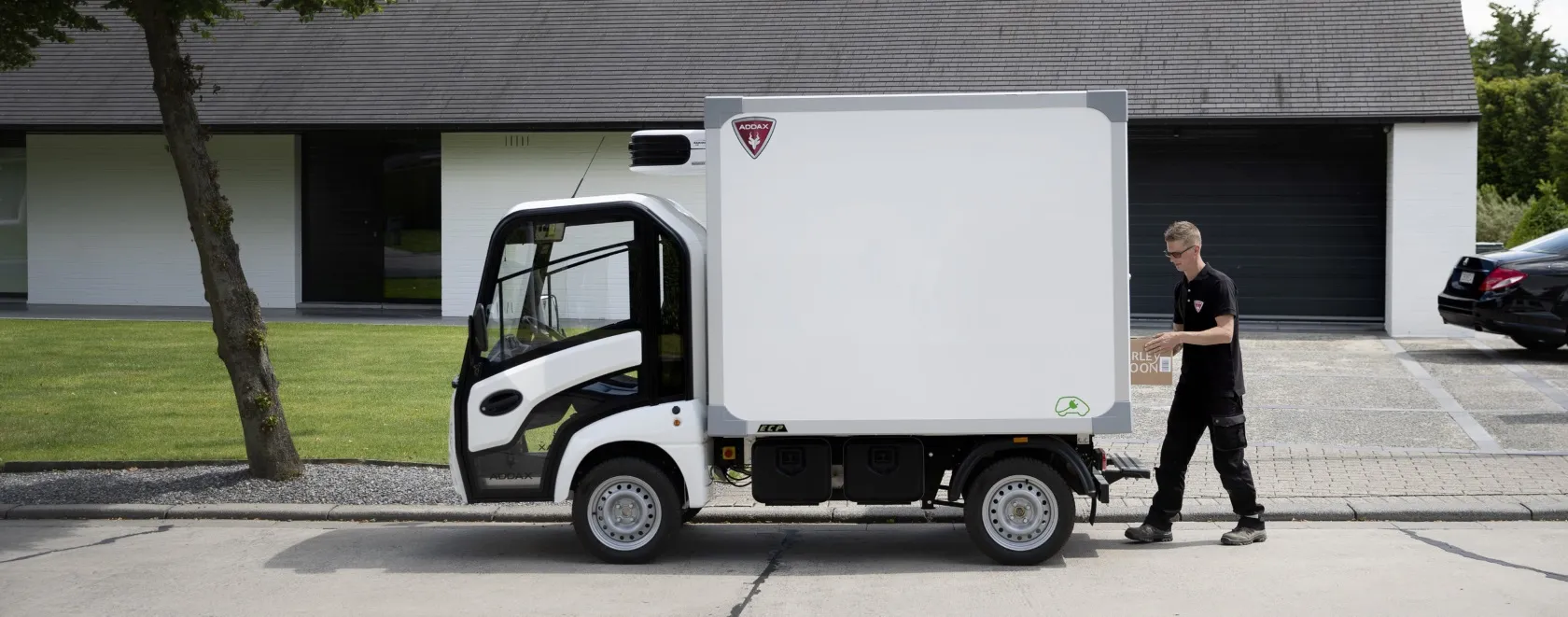
Importantly, small EV vans and such are emission-free and so can trundle around the low-emission zones of inner cities without incurring costs, said Kornel Staub, European business development manager for “last mile delivery” strategies at Addax Motors.
These zones, said Staub, speaking at the recent London EV Show, are gradually expanding away from city centres into the closer suburbs. This is making the EVs, such as made by Addax, the delivery mode of choice in areas where previously the internal combustion engine was king.
The business case for using a small electric delivery van was highlighted in a survey of logistics within Amsterdam city centre. It found that 85% of deliveries were for under 400kg and around 96% of the average total daily delivery distance for a vehicle was less than 150km. The rise, too, of on-line shopping means more short-distance inner city deliveries will be necessary.
This scenario is ideal for EVs as made by Addax, a Belgium manufacturer of small customised delivery and utility vehicles. Their vehicles are made for all tasks, from urban cargo and refrigerated delivery to tipping and landscaping duties. Addax vehicles come standard with high-quality technology geared towards driver safety and comfort, like front and rear disc brakes, 4G monitored technology and spacious two-person cabins.
But during a panel discussion, Efficiency of Light EVs in Last Mile Deliveries, attendees heard warnings that cold weather can severely limit the distance of a light EV before it requires recharging. Stuart Murphy, head of fleet transformation and integration at the UK postal and delivery service Royal Mail, said cold winter days can take as much as 30% off the distance normally travelled in a day by an EV.
Because of this reduced distance, planners must take into account possibly more charging times which can affect the availability of vehicles. Also, there could be more servicing requirements of the EVs, so logistics managers need to ensure sufficient repair staff are available if needed.
Even though a light EV might make use of a public charging station, this means it will not be out on the road delivering, thereby reducing its efficiency. In turn it might mean that more charging stations are needed to be ready at central hubs.
Bill Murray, co-founder of the London-to-Brighton Electric Car Rally, said part of the answer is for municipalities to invest in more quick-charging hubs. The trick is to have them in the right places for the right times.
Having such discussions shows that, at the end of the day, cities and mobility are on the right track, said Beres Seelbach, co-founder and chief executive of Onomotion, based in Berlin and maker of the ONO electric delivery bike. It is simply about a better quality of life.